
The AI paradox in companies: you can't plan your way into AI, but you can't wing it either
Most companies handle AI in one of two ways. Some plan carefully before they invest. Others invest in everything and see what sticks. Both feel responsible, both are partly right, and both leave organizations stuck in the same confusion. There is a third way, and it starts with a question few companies ask: What kind of problem is your AI problem, really?
Let's start with something we can probably all agree on: we are acting in uncertainty. No one knows what the future holds, and no one really knows how to handle not knowing.
This isn't new. Change has been accelerating for decades, and the uncertainty grew with it. Then came AI, and the result was even more confusion.
Inside organizations, that confusion looks like this. Endless options and opportunities. Endless pitfalls and risks. Endless decisions, and none of them are ever clear. None of us can be sure that we are spending our time, intellect, energy and creativity in the best way. There is always an equally good option somewhere else.
So what guides you?
Two truths that cancel each other out
Organizations know they need to change. The question is how. And when it comes to AI, two truths are true at the same time.
This is an article about AI, but the argument isn't really about AI. It holds for any situation where an organization has to change in uncertainty. AI just pushes it to the edge because it moves so fast and is unfamiliar to so many of us.

Truth #1: "AI is a tool. We need to know what to use it for."
The logic: we can't make use of AI if we don't know what we need it for. AI can be used for almost anything, so unless we know what we want, we'll just run around like headless chickens, wasting time and money. This leads to a lot of analysis, strategy and planning before investing. It feels good because you're being responsible, protecting the business and using resources carefully. Plus, you can say "yes" when someone asks if your company has an AI strategy, plan or policy.

Truth #2: "AI is a revolution. We need to move fast or get left behind."
The logic: we can't figure out what to use AI for unless we start using it. AI is moving too fast to wait for a plan. Every month spent analyzing is a month someone else spends getting ahead, so the answer is to get going and keep going. This leads to a lot of investments, encouragement and many initiatives happening at the same time. It feels good because there's a lot of activity going on. Also, you get to say "yes" when asked if your company has started using AI.
Here's the paradox. Both these truths are equally true and equally false at the same time. We can't figure out where to go if we don't start moving. And we can't start moving if we don't know where to go.
But there is a third way to move forward. (Of course there is, or we wouldn't have written this article.) It's about decision-making, and more specifically, how to make decisions under uncertainty.
How do you solve a problem like Maria AI?
The Cynefin framework (pronounced kuh-NEV-in) offers another way to think about this, based on research about complex systems and cognition. Its core idea is simple: different types of problems need different ways to solve them.
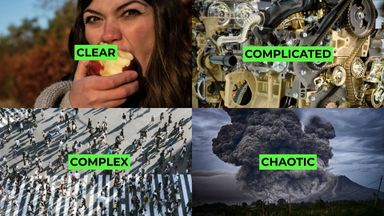
The framework describes four kinds of problems. Let's go through them one at a time and see which one your AI problem is.
For clear problems, the connection between cause and effect is obvious to everyone. As soon as you know what the problem is, you know what to do: you take in the situation, recognize what kind of problem it is, and apply the known solution. For example, if you're hungry, you eat.
Is your AI problem clear? No. If it were, you wouldn't be reading an article about it.
For complicated problems, the relationship between cause and effect is direct, but finding it may take analysis. The answer exists in advance, and with enough information and expertise, you can work it out before you act. You solve these problems by taking in the situation, analyzing it, and then responding. A machine is a good example. Whether it's a bicycle or a space rocket, enough data and analysis will tell you what's wrong.
This is the type of problem Truth #1 assumes AI is, and for complicated problems, analysis and planning are exactly the right approach. But no one has ever had your exact AI problem before, so there's no way to know in advance that your solution will work. Just thinking it through won't give you all the answers.
For chaotic problems, there's no visible connection between cause and effect because the rules that normally hold the situation together have broken down. There's no time to analyze or experiment, so you solve them by acting first, then seeing what happens and responding. In a house on fire, you go through a door even if you don't know what's on the other side, because waiting is worse.
This is how AI can seem, and acting first is close to what Truth #2 prescribes. But no matter how confusing it feels or however much panic you might experience, AI isn't chaos. There are patterns, and it's possible to see what works and what doesn't. Just doing things won't show you the right path.
For complex problems, the relationship between cause and effect can only be understood in retrospect. Meaning you can look back and see what worked, but you can never look forward and predict what will work next, and what worked once might not work again. You solve them by experimenting: try something small, see how the situation responds, then do more of what helps and less of what doesn't. Then try again. Getting kids dressed, fed and out the door in the morning is complex. Even after years of practice, you don't know for certain what will work, because every morning plays out differently, even though it may look just like yesterday.
This is your AI problem. To discover what works, you need to move forward by experimenting and learning as you go.
The distinction that matters most here is between complicated and complex. In everyday language, the words mean almost the same thing. In this framework, they don't: the solution to a complicated problem can be figured out in advance, while the solution to a complex problem must be explored.
Navigating complexity means learning by doing
If truth #1 wins in your organization, you might lean towards a strategy of thinking. Making responsible choices to handle your AI problem in the smartest way. That’s a wise choice for complicated situations, but it won’t cut the cake to help you tackle AI.
If truth #2 wins in your organization, you’re probably knee-deep in a strategy of acting. Being proactive, taking action, and at least not standing still. That would’ve been perfect in a chaotic situation, but you’re not in chaos.
In complex situations, you don’t learn first and act later, or the other way around. You learn through every step you take. To navigate the confusion AI brings to your organization, you need a particular way to move forward, one that helps you figure out where to go and learn how to get there at the same time. You need a strategy of learning (by doing).
So what does a strategy of learning look like in practice?
Well, it's like moving in fog. We can only see a few steps ahead, so we take small steps and pay attention to what each one tells us before we take the next. That's how we learn the terrain. And if we sense we're approaching a cliff, we step back and find another way forward.
The paying attention is what matters. In complex situations, doing and learning can't be separated, but doing only turns into learning if someone actually notices what happens. Otherwise, it's just doing.
This doesn't come naturally to most organizations. Business school taught you the opposite order: analyze all the data, find the best strategy, design the best management system, plan the implementation, then execute flawlessly. Most of us know that doesn't work.
Four things a strategy of learning requires
To succeed with a strategy of learning, your organization needs to be good at the following four things.

1. Setting and adapting a strategic direction
Not a detailed end state. In complexity, detailed end states never come true. They only create false pretenses. And a yes or no on whether you've arrived tells you nothing about whether you're heading the right way before you get there.
Instead, describe in relative terms what you want to see more and less of as you progress. Make it matter. If all you talk about is efficiency, you'll regress towards the middle, like everyone else.

2. Making change decisions in uncertainty
This means continuously directing your organization's creativity towards solving the right problem. It's not just about starting new initiatives. It's about constantly asking: Are we solving the right problem?
You maintain a portfolio of parallel experiments with different risk and outcome profiles. Some are likely to fail, but have a small downside. Others are high-risk, with a large upside if they work. And you're just as eager to kill initiatives as you are to start new ones: those that aren't solving the right problem and, even more importantly, those that aren't giving you the learning you need.

3. Experimenting
Experimenting isn't the same as doing a lot of cool stuff: running workshops, sending people to training, buying new tech, rolling out new processes. Experiments are parallel, safe-to-fail tests. They are small, time-boxed and hypothesis-driven.
Each experiment has two possible outcomes. A result—something that moves the needle—is nice to have. But learning is a must. An experiment that fails but teaches you something is fine. One that fails and teaches you nothing has wasted time, money and resources. So every experiment is evaluated, both while it runs and when it's done. That way, the learning is captured, and your next experiment and your next decision get smarter.
4. Making sense of change
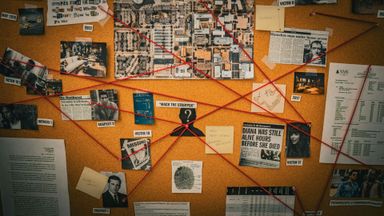
This is the hardest one. It means turning the abstract idea of continuous learning into tangible work. Sensemaking and learning need to be a capability: a skill you practice and get good at.
Learning needs a time, a place, someone responsible and an outcome. If you can't answer "what have we learned?", have you really learned anything, or have you just been running around?
This isn't about KPIs, metrics or the bottom line. Those are lagging indicators: they show up too late, and in complex situations you need to look back and review often. Sensemaking is about finding insights that make your experiments, decisions and direction smarter and more impactful over time. In practice, it means people talking to each other and asking: what does this mean for us, and what can we do with it?
You don't have to be stuck
The confusion is a natural response to uncertainty. What sets you apart is how you choose to handle it.
The strategy of thinking (analyzing, designing, planning) is rewarding. It feels like doing the right thing. So does the strategy of acting: people busy, tokens spent, new things produced faster than ever. But neither of them helps with the confusion. Thinking won't move you forward, and acting won't find the direction for you.
So the question isn't how to plan your way to the right use of AI, or how much you can get going. It's how you make sure you learn from what you do with AI. Answer that by deciding when the learning happens, where, who is responsible for it and what it should produce, and you have an AI strategy of learning that holds up in uncertainty.
You can't plan your way into AI, and you can't wing it. But you can learn your way there.
Don't hesitate to reach out if you want help getting started with a strategy of learning for your organization!
Anders Wengelin
CEO, Partner and Management Consultant