
What is reality-first transformation?
Most organizations change the same way: design the perfect system, roll it out, and hope that people use it. We call this map-first transformation. Reality-first transformation starts at the other end, with what people actually do, and doesn't draw the map until it's clear what actually works. Here's why that's a good idea.
Organizational change is complex and unpredictable. Complex because the opportunities and requirements are limitless, and because everything ties together—solve one problem and another pops up. Unpredictable because you have no real way of knowing that the work you’re doing will have the desired effect. And even if it does, the world might have changed while you were at it.
When humans encounter mess and uncertainty, they do what humans do: they try to tidy it up. So instead of dealing with the messy uncertainty of reality, most organizations' knee-jerk reaction is to replace it with something more manageable: a plan. A detailed, structured, beautifully formatted map of the journey ahead.
It's understandable. It's also why most transformations fail.
The actual goal: different behaviors
Every transformation ultimately aims for the same outcome: to change people’s behaviors. That new system, organizational restructure, process, or training program is there to help people do different things, or do things differently in order to create more value.
New behaviors are real. You can see them, you can hear them. They're the most concrete measure of whether anything has actually changed. And yet most organizations spend almost no time talking about behaviors, and enormous amounts of time talking about plans.
Those plans—flowcharts, roadmaps, org charts, and decks full of words that sound meaningful—are maps of a fantasy world. Abstractions of a reality that doesn't exist yet. The management team may get a comforting buzz of control from them. But the people doing the actual work will look at the map, look at their reality, notice they don't match, and most likely go back to doing what they've always done.
Every transformation involves a fundamental choice about what the system surrounding the people is for. If you start from reality—from the behaviors you want to see—the system becomes a tool to make those behaviors emerge, stick, and spread. If you start from the map—designing the system first—the people become a tool to make the system work. One approach creates real change, the other creates a lot of activity.
Map-first transformation—the traditional way
Map-first is most organizations' default approach to change. It handles complexity by sorting demands and possibilities into neat categories, and then crafting one-size-fits-all, up-front, top-down solutions to all problems. And it handles uncertainty by drawing up ambitious plans to put those solutions in place and execute them perfectly.
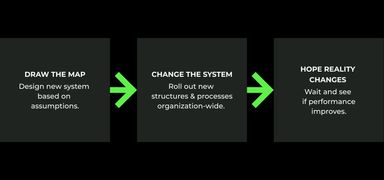
Here’s how it typically goes:
Step 1. Draw the map
The realization “We’re not performing as we should” quickly leads to the conclusion “The system must be broken”. The problem is analyzed. Solutions are designed. They consist of “hard” aspects, like organizational structure, processes, roles and responsibilities, and new tools and support systems. And of “soft” aspects, like skill training, values and norms, and culture.
Those solutions are then broken down into activities and placed sequentially in a plan. Tada! The map is ready. Time to start changing.
Step 2. Change the system
This is where change management enters. Ambitious plans require meticulous project management. The core idea: explain and convince. If everyone understands the map and how to follow it, change will succeed. If they don’t, they’ll be “change managed” until they do.
Systems and reorganizations are rolled out, people are sent to training, and values are communicated. Progress is defined as activities being executed, and outcome is measured by how well pieces of the map are put into place.
Step 3. Hope reality changes
When the new system is in place, change is implied. Since the new process tells people what to do, and they’ve been trained to do it, why wouldn’t they? Yes, that’s it! That’s the third step.
When the system is in place, the transformation is concluded! Crossing fingers and hoping that reality changes is all there is left. And if it doesn’t—if people don’t start doing things differently and performance isn’t fixed—it’s back to the drawing board and transformation starts all over again.
Map-first used to work, but it doesn’t anymore
The map-first approach, which is what traditional change management is based on, is designed for a time when organizations were less complex, and the world around them was more certain and predictable. A time when the upfront assumptions made at the start of a change were likely to be valid.
Today, the likelihood that the analysis and conclusions we make at the beginning will hold for a full transformation spanning months and years is close to zero, and map-first is not designed for adaptation or revalidation of assumptions.
The result of map-first transformation is massive amounts of time, energy, and resources spent on transformation activities, but little change in how work actually happens—in reality.
Not only is all that work in vain, but those solutions also come at a price: poorly adopted systems, processes, and structures will ultimately slow performance, add overhead in administration and coordination, and require ongoing maintenance.
Reality-first transformation—the new way
In complex, unpredictable environments, a reality-first approach is better for transformation. Skip the unnecessary detour through time-consuming, assumption-packed exercises of creating imaginary maps of a reality that still does not exist. Make changes in reality instead!
Reality-first handles complexity by diving straight into the reality where work takes place, and creating solutions adapted where work actually happens. And it handles uncertainty by building the capability to experiment and to make deliberate, dynamic decisions continuously.
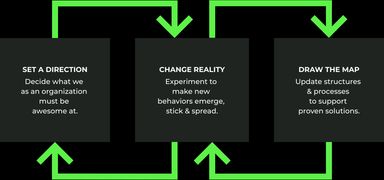
Here’s how it works:
Set a direction
The direction is your high-level strategic statement. It tells your organization where you’re going and how you’re trying to get there. In complexity, strategic intent is better described as a direction than a detailed picture of a solid-state end goal and a step-by-step map of how to get there.
A direction is a meaningful description of the difference between the current state and what we wish to see in the future. It’s not meant to answer all conceivable questions about the future; it’s meant to describe movement and help the organization determine whether it’s moving in the right direction.
Answer these three questions, and you’re good to start changing:
- “How should we succeed?” This is preferably a one- to three-sentence description of the value you’re creating, for whom, and how you chose to create it.
- “What do we need to be awesome at?” These are your core capabilities, the ones that set you apart and define your relevance to this world. No one can be awesome at everything, and making deliberate and candid choices will increase your chances of becoming awesome at something.
- “What should people do differently?” These are the behaviors that actually create value, in reality. It’s not how people are or how they think; it’s about what they do and say. Difficult? Sure, it’s probably unfamiliar work, but if YOU can’t tell what value-creating work looks like, how should they?
You know you have a clear enough direction to start changing when a pattern has emerged that allows you to see what you want to see more and less of as you move forward. Progress is not when the transformation has performed change activities A, B, and C; it’s when people are doing more of X, Y, and Z.
Change reality
Now that you know what people should do differently, help them do it. It’s that simple, even though it might not be easy. The idea is to start helping people adopt new behaviors in one or a few contexts, and then make them spread from there.
You do this by running many small, parallel experiments on the conditions that shape everyday work, and learning continuously how those changes affect behavior. Most of the time, people don’t need new formal processes, redefined roles, or clear responsibilities. They need two things:
- Motivation. This is the understanding that a new behavior will help them fulfill their everyday goals, doesn’t clash with their identity, fits social norms, is aligned with incentives, and has leadership legitimacy. It’s what makes people want to do it.
- Ease. These are the skills, knowledge, and tools to do it, opportunities where it makes sense to do it, and processes and organizational delegation that don’t block it. It’s what makes people feel they can do it.
If motivation and ease are sufficiently high, the behaviors will happen. People will do it.
Draw the map
As new solutions take form and are proven to support desired behaviors, they are continuously established as scaffolding to help behaviors stick and spread to other contexts.
The “map” here is the “management system,” but in the broader sense. Not just the formal documentation, but also the de facto means of running daily work: onboarding, training, routines, leadership, flow of information, recurring meetings, and, in fact, documentation.
What was once a complex challenge becomes a known pattern that can be taught, replicated, and embedded into how work happens. Remember, though: in complex systems, solved problems tend not to stay solved, and maps will need to be redrawn continuously.
The goal: long-term adaptability, not a one-off successful change project
Reality-first transformation is the act of continuously changing reality and redrawing the map. Your transformation is not a one-off change project or even a program, it’s how the organization renews itself continuously. It’s not the job of a select few ‘change managers’ running initiatives, the work belongs to everyone who wants new behaviors. Reality-first doesn’t mean plans, designs, and measurements are forbidden, they just stop being the goal and start being a means to help behaviors emerge.
The pros and cons of reality-first transformation
Reality-first changes the return on investment for your transformation. Impact arrives earlier, in many small increments rather than a single delayed big-bang after a long rollout. Solutions fit the reality of each context better because that reality shaped them. Risk stays manageable, since you can validate assumptions and adapt as you go. And the more your organization changes this way, the better it gets at changing, as adaptivity is built in as a core capability. That’s the real competitive edge.
But there are, of course, some trade-offs. Selling a reality-first approach when the system expects map-first takes courage. If you’re the only one who values reality over maps, it gets lonely. Managers will lose the illusion of control as they have to make decisions without a map. And progress is harder to quantify, which makes steering committees nervous.
In short: We’re not telling you reality-first is easier than map-first. Transformation is never easy. What we are telling you is that at the end of the day, watching new behaviors emerge, stick and spread is a reward that makes the challenge of choosing the path less traveled worth it!
Anders Wengelin
CEO & Management Consultant