Changing people's behavior is hard work: messy, non-linear and often uncomfortable. But that's not the problem—it's that most methods aren't built to handle this reality. Ours is.
Here's how we do it, and how you can too.

Changing people's behavior is hard work: messy, non-linear and often uncomfortable. But that's not the problem—it's that most methods aren't built to handle this reality. Ours is.
Here's how we do it, and how you can too.

Reality keeps changing, faster and more unpredictably than ever. So organizations must adapt to stay relevant. But traditional transformation methods are too slow and inefficient to keep up. Usually, not much has changed in the end. Or if it did, it took so long that reality changed, again.
We do transformations differently. In uncharted territory, you can't start by drawing the map. Once you’ve decided on what direction you want to move in, you have to get out and explore which route leads there in reality. Only then does it make sense to draw a map to help others get there, too.
Transformations, if done right, are messy business. Most people (and boards, which are made up of people) don't like that. They prefer neat and linear processes with a clear start and endings, because that creates an illusion of control.
And so they start by drawing the map. And then they follow it, ticking off checkpoints as they go. When all boxes are ticked, the transformation is done—impact or no impact. It goes something like this:
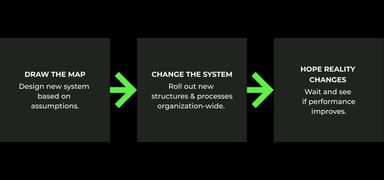
In reality-first transformations we embrace the mess because ... Well, there's no other way to do it.
Firstly, complex problems can't be solved by analysing them, no matter how long or hard you try. There are too many unpredictable elements. The only way to know for sure if something will work, is to try. That's why we work non-linearly—experimenting, learning and adjusting course as we go.
Secondly, real change (and impact) don't happen until people start doing different things or doing things differently. That's why we focus more on changing behaviors than on role descriptions and processes. The rest can wait until we've found a solution that works.
There's a lot of research and theories to back this up, which we'll gladly go on and on and on about. But simply put, reality-first looks something like this:
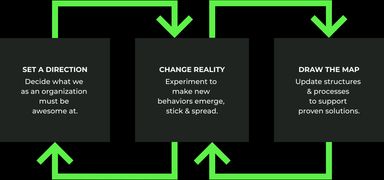

Map-first delays results until everything is planned and rolled out. Reality-first creates impact early through small moves that generate immediate learning and value.

Map-first solutions are built for the plan, not for real life. They look structured but often miss how work actually happens. Reality-first solutions are shaped by context and proven in practice.

Map-first commits big before reality has spoken. If assumptions are wrong, the cost is high. Reality-first reduces risk by testing direction early and adjusting while the stakes are still small.

Reality-first builds the muscle of continuous navigation. So you don’t just change once, you get better at changing. And that (adapt)ability is the real competitive edge.
Not sure where to start? Here are three ways we typically help organizations take the first step.

Not sure what you need to change? That's fine. Most people aren't, and the ones who are absolutely certain are usually wrong about something. In a few sessions, we help your leadership team get clear on:
Why do you need to change?
What do you need to be awesome at to succeed?
How do you know if you're moving in the right direction?
That's enough to start moving, and moving is how you find out if you're right.

Truly adaptive organizations make change decisions continuously. They're constantly asking which initiatives to back, which to kill, and where to move resources. That's what portfolio management is—not a planning tool, but a decision-making practice.
Used well, it's how you direct creativity and investment toward the right problems at the right time. Used badly, it's just a Gantt chart in a fancy dress.
We help you set it up so it actually works!

This strategy is not a plan to follow, but a set of hypotheses to test and adjust. Enough to get people moving in the same direction—even when you're not in the room—without locking you into answers you haven't tested yet.
In a few weeks, we help your leadership team sketch out the first draft:
What needs to change, and why?
So everyone is working from the same understanding, not their own interpretation.
How do we make it stick?
So change actually happens, and doesn't quietly disappear after the first few wins.
How do we make it spread?
So what works with 20 people has a fighting chance with 2,000.
We love helping the organisations that keep Europe running—critical to our everyday lives, subject to constant change, and too often taken for granted.

The energy sector is in transition: from stable growth for a few large players, to a fragmented market with new competitors, new business models, and increasing demands from consumers. Time to start building what comes next, fast enough to matter.

The new geopolitical reality is putting pressure on Europe's space sector. An industry used to long development cycles, low tolerance for failure, and a handful of large government contracts. Expected to collaborate, experiment, and get ready to launch faster than ever.

The Swedish public sector is facing higher demands on healthcare with fewer resources, due to an aging population. In a system designed for predictability and reliability, innovation feels risky. Yet necessary, to find smarter ways for the regions to operate.

The telecom industry is a vital part of our infrastructure as well as a fast-moving and unpredictable consumer market. One side values stability and reliability, the other going to market quickly with new products, services and business models. It's a balancing act.

Banks are under pressure from faster, leaner competitors, while carrying the weight of dated processes and technical debt. Scale and stability are real advantages, but they also slow you down. To win: figure out how to move faster without breaking something crucial.

Traditional, linear change might look tidy on paper, but real life rarely behaves that way. When it comes to complex organizational transformations, a non-linear, experimental and emergent approach to change isn’t just a nice alternative. It’s the smartest choice.

If your transformation initiative isn’t getting traction, it’s tempting to blame people for being “resistant to change.” But here’s a better idea: design the change so that it actually works. Not just in theory, but in reality.

In real life, change is messy and unpredictable. At Friktion, we lean into the tension, embrace complexity, and experiment our way forward. Our newsletter is where we share insights about what it takes to transform organisations, in reality.
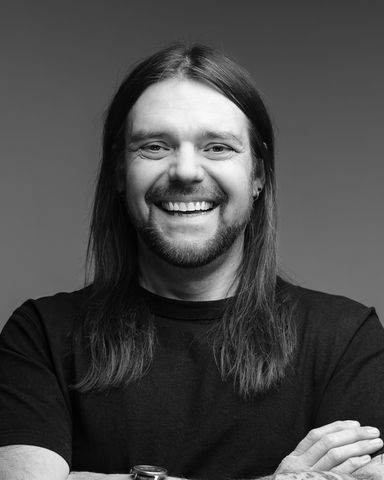
CEO, Partner and Management Consultant
+46707178983anders@friktion.sewengelinDrop Anders an email now